SURINAME ORIGINALS · KNOWLEDGE & STORIES
Suriname: people, cultures and languages
Understanding a country starts with its people. Explore original inhabitants, community histories and the languages in which knowledge is shared.
Background information · sources consulted 16 October 2026
Back to Discover
Many histories, one country
Suriname’s society includes Indigenous peoples, Afro-Surinamese and Creole communities, Maroons, Hindostani, Javanese, Chinese, Jewish and Lebanese Surinamese, Boeroes, people with Portuguese roots and many other or mixed backgrounds. No list can capture every family or identity. This overview is an invitation to learn more, rather than a boundary around who belongs.
Sources: Overheid Suriname — land en culturele verscheidenheid · Overheid Suriname — herdenking Boeroe-gemeenschap, 2025 · Overheid Suriname — Portugese immigratie en MadeiSu
The original inhabitants
VIDS identifies Kaliña, Lokono, Trio and Wayana as the four largest Indigenous peoples in Suriname. It also names Akuriyo, Apalai, Wai-Wai, Katuena/Tunayana, Mawayana, Pireuyana, Sikiiyana, Okomoyana, Alamayana, Maraso, Sirewu and Sakëta. Spellings and self-identification vary; names alone do not explain the distinct lives of villages and families.
VIDS brings together traditional village authorities. Its account of cultural continuity, knowledge and governance is a reminder to make room for communities’ own voices. We want specific community stories to be told with the involvement of those concerned.
Afro-Surinamese and Maroon histories
Creole and Maroon identities are not interchangeable. The Nationaal Archief describes Maroon communities formed by people who escaped slavery, naming Ndyuka, Saamaka, Matawai, Aluku, Kwinti and Paamaka. It also highlights oral traditions such as Mato storytelling. Written colonial records therefore provide one perspective, rather than a complete account of community history.
Sources: Nationaal Archief — Marrongemeenschappen en vredesverdragen
Hindostani, Javanese and Chinese roots
The Nationaal Archief documents indentured migration from British India during 1873–1916, while also noting earlier movements from Caribbean colonies. Javanese indentured migration began in 1890 and continued until 1939. The government’s heritage material connects Javanese-Surinamese cultural life with food, music and arts, including saoto, bami, gamelan, wayang and batik.
Chinese migration involved several phases and routes. Archival registers offer a starting point for family research, while contemporary Chinese-Surinamese experiences extend well beyond the history of indentured labour. Within each of these communities, regional roots and family experiences differ.
Sources: Nationaal Archief — Hindostaanse contractarbeid
Sources: Nationaal Archief — Javaanse contractarbeid · Overheid Suriname — Heritage Month
Sources: Nationaal Archief — Chinese contractarbeid · Overheid Suriname — Heritage Month
Jewish Suriname and Jodensavanne
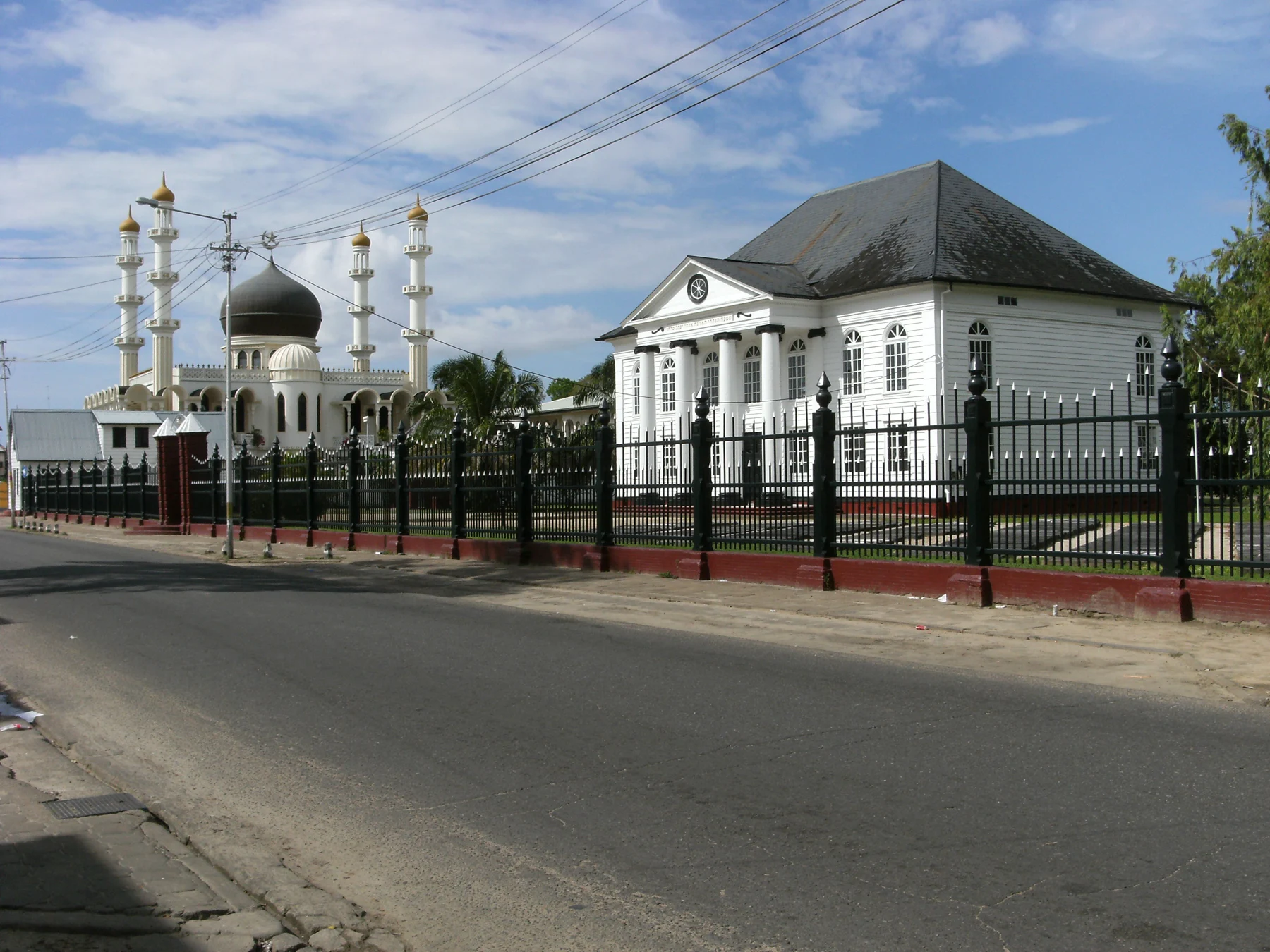
Jewish history is an integral part of Suriname. UNESCO’s account of Jodensavanne and Cassipora places early Jewish settlement alongside the lives of free and enslaved people of African and Indigenous descent. The site became World Heritage in 2023. Recognising Jewish community life also means recognising the colonial and slavery context in which these settlements developed.
Sources: UNESCO — Jodensavanne en Cassipora
Smaller and intertwined histories also matter
Boeroe heritage is connected with Dutch farming families who settled in 1845. Government heritage reporting also discusses Portuguese immigration and Madeiran descendants. Portuguese migration and Portuguese-Jewish history should not automatically be treated as the same story. Lebanese Surinamese, other communities and people with several family roots belong in the wider picture too.
Sources: Overheid Suriname — herdenking Boeroe-gemeenschap, 2025 · Overheid Suriname — Portugese immigratie en MadeiSu · Overheid Suriname — land en culturele verscheidenheid
Languages across everyday life
Dutch is the official language. Research presented by the Taalunie in 2019 also discusses Sranantongo and Sarnami, with language use varying across family life, education, work and public settings. Suriname has other community and Indigenous languages as well. Sranantongo should therefore not be described as the language of all Indigenous peoples.
Our website uses Dutch, English and Sranantongo. A language choice does not mean every new article has already been translated: the Sranantongo option currently opens that language’s home page for this new collection.
Sources: Taalunie — onderzoek naar taalgebruik in Suriname, 2019 · Overheid Suriname — land en culturele verscheidenheid
Our approach to telling these stories
We value differences, exchange and the people behind knowledge. We do not claim ownership of shared traditions or cultural symbols. Personal stories and portraits require permission and agreed attribution. If you want to contribute another perspective or a correction, please contact us. This collection can grow without pretending to contain everything about Suriname.
Written in our own words using the linked sources. Mentioning an institution does not imply partnership or endorsement. Product ingredients, origin and nutritional information require separate confirmation.
Share a question or contribution